 College of Medicine
 College of Dentistry
 College of Architectural Eng & Digital Design
 College of Business Administration
 College of Law
 University Preparatory Program
 College of Pharmacy and Applied Medical Sciences
 Student Affairs Department
 General Directorate of Planning, Development, and Quality Assurance
 تواصل معنا
Telephone : 0114949000
Fax : 0114949490
Email : info@dau.edu.sa
The General Surgery Club, affiliated with the Medical Pathways Club at the College of Medicine, Dar Al Uloom University, organized an introductory session on General Surgery.
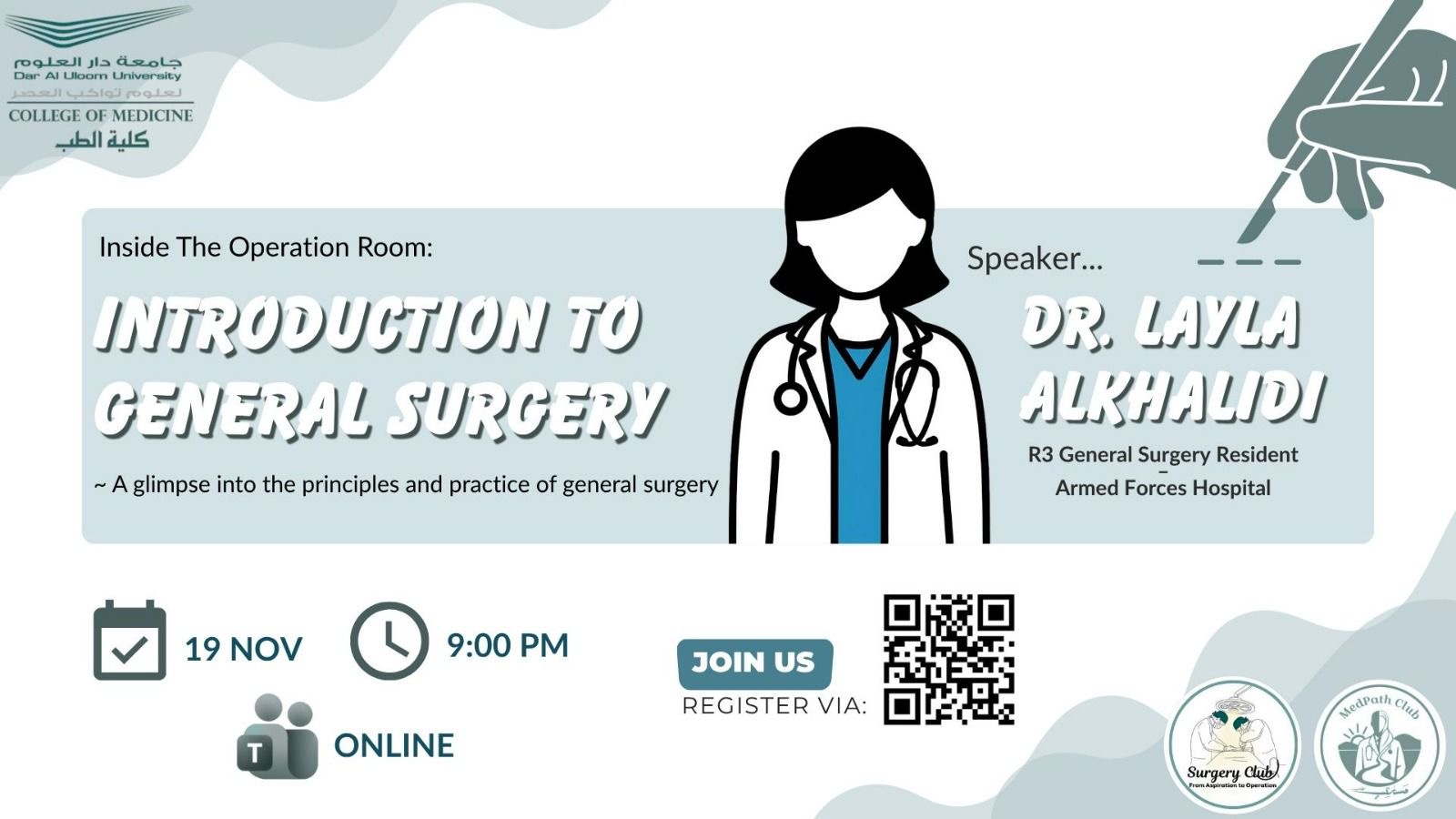
The general surgery club of the College of Medicine at Dar Al Uloom University organized online lecture about “Introduction to General Surgery” lecture.
Brief description of the event:
With the aim of introducing students to the General Surgery specialty track and its requirements, the Student Council of the College of Medicine at Dar Al Uloom University hosted a lecture titled “INTRODUCTION TO GENERAL SURGERY”. The lecture was delivered by Dr. Layla Alkhaldi, an R3 General Surgery resident at the Armed Forces Hospital .
The lecture covered several key, detailed aspects of the surgical career path, most notably:
* Introduction to the Saudi Board of General Surgery Program: It was explained that the program involves five years of structured surgical residency training under the Saudi Commission for Health Specialties (SCFHS).
* Levels and Stages of Training:
* Junior Level (R1-R3): Focuses on fundamentals, emergency surgery, perioperative care, and basic operative skills.
* Senior Level (R4-R5): Characterized by increased independence, advanced operative exposure, leadership roles, and specialty-focused rotations.
* Rotations: The Junior level includes 24 months of general surgery rotation and 12 months outside general surgery, encompassing rotations in the Intensive Care Unit, Emergency Department, Vascular Surgery, Pediatric Surgery, Plastic Surgery, and an Elective rotation.
* Assessments and Examinations: The program requires the Part 1 Exam (taken during Junior years) focusing on basic sciences and surgical fundamentals, and the Part 2 (Final Exam) in the last year, which includes written and clinical components (OSCE/Viva). Trainees must also complete annual promotion exams, a logbook, research, and workplace-based assessments.
* Subspecialties (Fellowship Options): Dr. Layla Alkhaldi reviewed the fellowship options available after completing the General Surgery residency, including:
* Colorectal Surgery
* Breast & Endocrine Surgical Oncology
* Hepatobiliary & Pancreatic Surgery
* Trauma & Acute Care Surgery
* Minimally Invasive & Bariatric Surgery
* Vascular Surgery
* Transplant Surgery
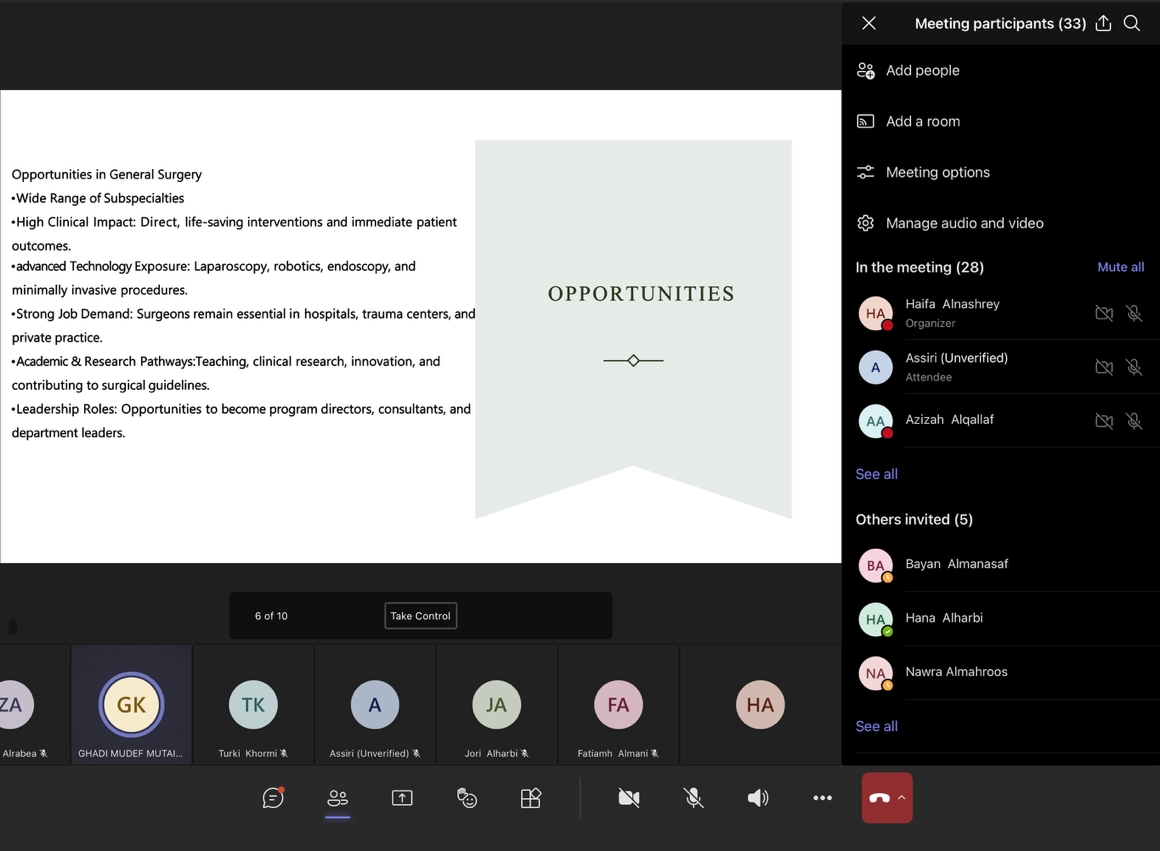
* Opportunities in General Surgery: Emphasis was placed on the wide range of subspecialties, the High Clinical Impact through direct, life-saving interventions, exposure to Advanced Technology like laparoscopy, robotics, and endoscopy, strong job demand, and pathways for Academic & Research and Leadership Roles.
* Challenges in the Surgical Path: The audience was alerted to the Long Training Path (five years residency plus subspecialty fellowships), the difficulty of achieving Work-Life Balance due to night shifts, on-calls, and emergencies, High Stress & Responsibility, physical and mental exhaustion from Long OR hours, and the requirement for Continuous Learning.
* Female Doctors in Surgery: A segment was dedicated to discussing the challenges for female doctors, where the lecture highlighted the significant growth in awareness in the surgical field, stating: “there is no meaningful difference between female and male surgeons in skill, potential, or professional achievement”.
The lecture concluded with an Interactive Q&A session with the audience.