Dar Al Uloom University
  • Contact Us
  • SIS
  • LMS
  • EMAIL
  • IT
  • Support
  • Jobs
  • Apply Now
Search
Log In
  • About
    • President Message
    • Leadership & Organization
    • Vision, Mission, and Values
    • Graduate Attributes
    • Accreditation
    • Planning, Development & Quality Assurance
    • Policies & Procedures
    • News and Events
  • Admissions & Enrollment
    • Undergraduate Admissions
    • Graduate Admissions
    • Tuition & Fees
    • Scholarship, Grants & Loans
    • Academic Calendar
    • Registration
    • Transfer to DAU
  • Academics
    • Colleges
    • Undergraduate Programs
    • Graduate Programs
    • University Preparatory Program (UPP)
    • Academic Advising
    • Teaching and Learning 
  • Research & Innovation
    • Research
    • Entrepreneurship, Innovation & Knowledge Transfer
    • Learning Resources&Libraries
    • Scientific Council 
  • Life at DAU
    • Student Clubs 
    • Student Councils 
    • Student Services 
    • Student Activities 
    • Career Guidance
  • Outreach & Impact
    • Career Fairs 
    • Alumni
    • Community Engagement 
    • Industry Partnerships 
  1. Dar Al Uloom University

Home

Dar Al Uloom University
  • About
    • President Message
    • Leadership & Organization
    • Vision, Mission, and Values
    • Graduate Attributes
    • Accreditation
    • Planning, Development & Quality Assurance
    • Policies & Procedures
    • News and Events
  • Admissions & Enrollment
    • Undergraduate Admissions
    • Graduate Admissions
    • Tuition & Fees
    • Scholarship, Grants & Loans
    • Academic Calendar
    • Registration
    • Transfer to DAU
  • Academics
    • Colleges
    • Undergraduate Programs
    • Graduate Programs
    • University Preparatory Program (UPP)
    • Academic Advising
    • Teaching and Learning 
  • Research & Innovation
    • Research
    • Entrepreneurship, Innovation & Knowledge Transfer
    • Learning Resources&Libraries
    • Scientific Council 
  • Life at DAU
    • Student Clubs 
    • Student Councils 
    • Student Services 
    • Student Activities 
    • Career Guidance
  • Outreach & Impact
    • Career Fairs 
    • Alumni
    • Community Engagement 
    • Industry Partnerships 


Strategic Plan Structuring:

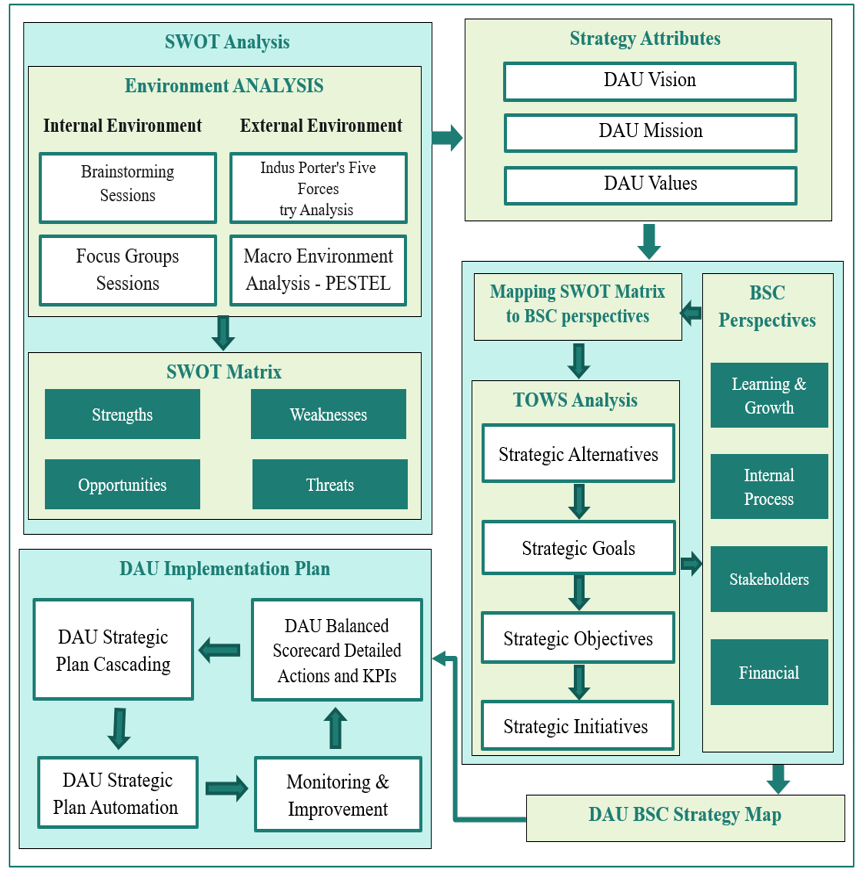
DAU’s second strategic plan (2023-2027) was developed using a variety of strategic analysis tools. The SWOT analysis identifies and analyses internal strengths and weaknesses as well as external opportunities and threats. To identify strengths and weaknesses, we conducted many brainstorming sessions and focus groups with internal and external stakeholders. To identify opportunities and threats, we rely on Porter’s Five Forces framework, which identifies and analyses the five competitive forces shaping the private higher education industry in Riyadh, and on the PESTEL framework for analyzing macro-environmental factors affecting the industry holistically.

The SWOT analysis, however, provides no guidance, prioritizes issues, or suggests strategic alternatives because it only provides a snapshot of a firm at a particular moment in time. Taking a SWOT analysis, a step further, we created the TOWS Matrix, which offers an advanced analysis that generates possible strategic alternatives by matching internal strengths and weaknesses with external opportunities and threats.    

The strategic planning methodology adopted is the Balanced Scorecard (BSC) framework developed by Robert Kaplan and David Norton (1992). BSC is a strategic planning and management framework that helps organizations translate their vision and strategy into action. It does this by providing a framework for defining, monitoring, and managing performance objectives in four perspectives: financial, stakeholders, internal processes, and learning and growth.

–

The figure below shows the structure of developing DAU’s Second Strategic Plan (2023-2027):
–

The BSC Framework:

            The BSC framework is widely used in large companies, as well as many reputable universities, as a strategic planning framework. Instead of focusing solely on operational performance and financial indicators, this framework links strategic performance to measurable goals and objectives in four perspectives. The four perspectives of the balanced scorecard framework in our second strategic plan are as follows:

  1. Learning and Growth Perspective: According to this perspective, the university’s objectives and measures aim to close a gap between current human capital, informational capital, and organizational capital, on the one hand, and the environment needed to maintain success, on the other, and to ensure sustainable performance in the future.
  2. Internal Process Perspective: The objectives and measures in this perspective are meant to identify the key processes that university must excel at to continue adding value to students and ultimately shareholders. These processes include learning, research, community engagement, partnerships, and management.
  3. Stakeholder Perspective: The objectives and measures in this perspective focus on maximizing the value proposition of the costumer, through improving stakeholders’ satisfaction, loyalty, and perception of the university in terms of its ability to provide enriching learning experiences to its students.
  4. Financial Perspective: Through the objectives and measures in this perspective, the university aims to ensure that by meeting the objectives and measures chosen in the other three perspectives, its financial performance will be positively impacted by growth prospects, improved asset utilization, and cost-savings.

–

Advantages of adopting the BSC framework:

Several aspects of the strategic planning process at the university are expected to be positively impacted by our adoption of the balanced scorecard framework in our second strategic plan, most notably:

  • BSC allows DAU’s performance improvement strategies to be mapped and links to multiple organizational levels.
  • The framework identifies cause-and-effect relationships among the four perspectives of the Balanced Scorecard.
  • The strategy map component of the BSC provides a graphical description of DAU’s strategy, including the interrelationships of its elements. This map is considered the blueprint for the organizational plan.
  • The BSC’s cascading process gives DAU a tool for taking the scorecard down to departmental, unit, divisional, or individual measures of performance, resulting in a consistent focus at all organizational levels. From DAU’s BSC, there will be a BSC for each unit, containing the same goals, initiatives, and performance indicators adapted to fit the unit’s responsibilities. Therefore, balancing will not only take place at the level of the four perspectives, but also at the organizational level. 
  • The cascading of the scorecard also presents DAU’s faculties and staff with a clear image of how their individual actions make a difference in relation to DAU’s strategic objectives. The cascaded scorecard creates alignment among the performance measurement outcomes throughout the various organizational levels.
  • The BSC is a powerful communications tool across all DAU levels.  
  • Automation of the balanced scorecard is a valuable tool for monitoring performance metrics and implementing strategies to achieve strategic objectives. Our strategy map, performance measures, and related initiatives are all accessible through the dashboard.

University Logo

Programs

  • Graduate Programs
  • Undergraduate Programs
  • Online Programs
  • Colleges & Departments

Faculties

  • Faculty of Medicine
  • Faculty of Dentistry
  • Faculty of Law
  • Faculty of Business Administration
  • Faculty of Pharmacy and Applied Medical Sciences
  • Faculty of Architectural Engineering & Digital Design
  • University Preparatory Program

Quick Links

  • Apply Now
  • About
  • Articles
  • Academic Calendar
  • CPL Help
  • Events
Contact Info

0096614949000

info@dau.edu.sa

KSA, Al Falah, Riyadh 13314, Saudi Arabia

Important Numbers
  • دليل الهاتف

College of Law

المسمى الوظيفي رقم هاتف المكتب البريد الإلكتروني
عميد الكلية 011-4949264 mufleh@dau.edu.sa
وكيل الكلية 011-4949386 m.alsubaie@dau.edu.sa
رئيس قسم القانون العام 011-4949157 aghrir@dau.edu.sa
رئيس قسم القانون الخاص 011-4949388 halghashami@dau.edu.sa
مساعد إداري في الكلية 011-4949354
011-4949224
011-4949342

College of Business Administration

المسمى الوظيفي رقم هاتف المكتب البريد الإلكتروني
عميد الكلية 011-4949366 a.alsultan@dau.edu.sa
وكيل الكلية 011-4949265 a.alshimai@dau.edu.sa
رئيس قسم التسويق 011-4949225 makader@dau.edu.sa
رئيس قسم الموارد البشرية 011-4949290 taoufik@dau.edu.sa
رئيس قسم المحاسبة 011-4949170 a.ayed@dau.edu.sa
رئيس قسم المالية 011-4949109 aadabuhommous@dau.edu.sa
مساعد إداري في الكلية 011-4949330
011-4949256
011-4949156
011-4949332

College of Architecture Engineering & Digital Design

المسمى الوظيفي رقم هاتف المكتب البريد الإلكتروني
عميد الكلية 011-4949352 a.alghunaimi@dau.edu.sa
وكيل الكلية 011-4949059 lobna.m@dau.edu.sa
رئيس قسم هندسة العمارة 011-4949151 makader@dau.edu.sa
رئيسة قسم التصميم الداخلي 011-4949116 hossam.e@dau.edu.sa
رئيسة قسم التصميم الجرافيكي 011-4949214 dnafadi@dau.edu.sa
مساعد إداري في الكلية 011-4949189
011-4949323
011-4949145
011-4949141

College of Medicine

المسمى الوظيفي رقم هاتف المكتب البريد الإلكتروني
عميد الكلية 011-4949017 a.aljumah@dau.edu.sa
وكيل الكلية 011-4949166 abdulmajed.d@dau.edu.sa
وكيل الكلية للشؤون الإدارية 011-4949261 aalhamidi@dau.edu.sa
وكيلة كلية الطب لشؤون الطالبات 011-4949464 taltamimi@dau.edu.sa
مساعد إداري في الكلية 011-4949216
011-4949002
011-4949012
011-4949199

College of Dentistry

المسمى الوظيفي رقم هاتف المكتب البريد الإلكتروني
(التسجيل و الدعم الفني) 011-4949357-011-4949315 dentistry.support@du.edu.sa
مكتب عميد الكلية 011-4949307 cdt.deanoffice@du.edu.sa
مكتب وكيل الكلية 011-4949132 dentistry@du.edu.sa
الدراسات العليا 011-4949357 dentistry@du.edu.sa
الاستقبال/حجز المواعيد: 011-4949397
واتساب(الاستقبال) 011-4949397
علاقات المرضى 011-4949205

College of Pharmacy and Applied Medical Sciences

المسمى الوظيفي رقم هاتف المكتب البريد الإلكتروني
رئيس قسم التمريض 011-4949074 a.ismail@dau.edu.sa
مساعد إداري في الكلية 011-4949314

عمادة القبول والتسجيل

المسمى الوظيفي رقم هاتف المكتب البريد الإلكتروني
العميد 011-4949125 aalazman@dau.edu.sa
مكتب العمادة 011-4949334 falwakeel@dau.edu.sa
مكتب العمادة 011-4949037 aalsadoun@dau.edu.sa
التسجيل 011-4949014 ananad@dau.edu.sa
التسجيل 011-4949292 trian@dau.edu.sa
التسجيل 011-4949252 raya@dau.edu.sa
القبول 011-4949011 haitham@dau.edu.sa
القبول 011-4949253 salyahyawi@dau.edu.sa
القبول 011-4949130 r.qahtani@dau.edu.sa
القبول 011-4949045 a.alattas@dau.edu.sa

عمادة الدراسات العليا والبحث العلمي

المسمى الوظيفي رقم هاتف المكتب البريد الإلكتروني
العميد 011-4949300 bulquees@dau.edu.sa
مساعد إداري 011-4949335 oalnajdi@dau.edu.sa
مساعد إداري 011-4949220 stalib@dau.edu.sa
مساعد إداري 011-4949176 hanadi.b@dau.edu.sa

إدارة شؤون الطلاب

المسمى الوظيفي رقم هاتف المكتب البريد الإلكتروني
مدير الإدارة 011-4949053 nalanazi@dau.edu.sa
مساعد إداري 011-4949129 ralbassam@dau.edu.sa
مساعد إداري 011-4949287 lalhoireni@dau.edu.sa
مساعد إداري 011-4949136 halrajhi@dau.edu.sa

إدارة العلاقات العامة

المسمى الوظيفي رقم هاتف المكتب البريد الإلكتروني
مدير الإدارة 011-4949009 public.relation@du.edu.sa
مساعد إداري 011-4949022
مساعد إداري 011-4949084
مساعد إداري 011-4949409

الإدارة المالية

المسمى الوظيفي رقم هاتف المكتب البريد الإلكتروني
مدقق مالي 011-4949068 finance@du.edu.sa
محاسب 011-4949407
محاسب 011-4949034

إدارة تقنية المعلومات (itcsupport@du.edu.sa)

المسمى الوظيفي رقم هاتف المكتب البريد الإلكتروني
مدير الإدارة 011-4949238 oasal@dau.edu.sa
دعم فني 011-4949021 jeyson@dau.edu.sa
دعم فني 011-4949280 moh.heffnie@dau.edu.sa
دعم فني 011-4949114 geneveve@dau.edu.sa
دعم فني 011-4949128 lina.a@dau.edu.sa
مبرمج 011-4949277 ajmal@dau.edu.sa
مبرمج 011-4949094 medhat@dau.edu.sa
مهندس شبكات 011-4949181 shehryar@dau.edu.sa
مدير أنظمة التشغيل والخوادم 011-4949406 amer@dau.edu.sa
Maslak
( مسلك ) الشروط والإجراءات نموذج طلب قرض تعليمي الاسئلة الشائعة لصندوق مسلك
How to Apply
خطوات التقديم هنا.